
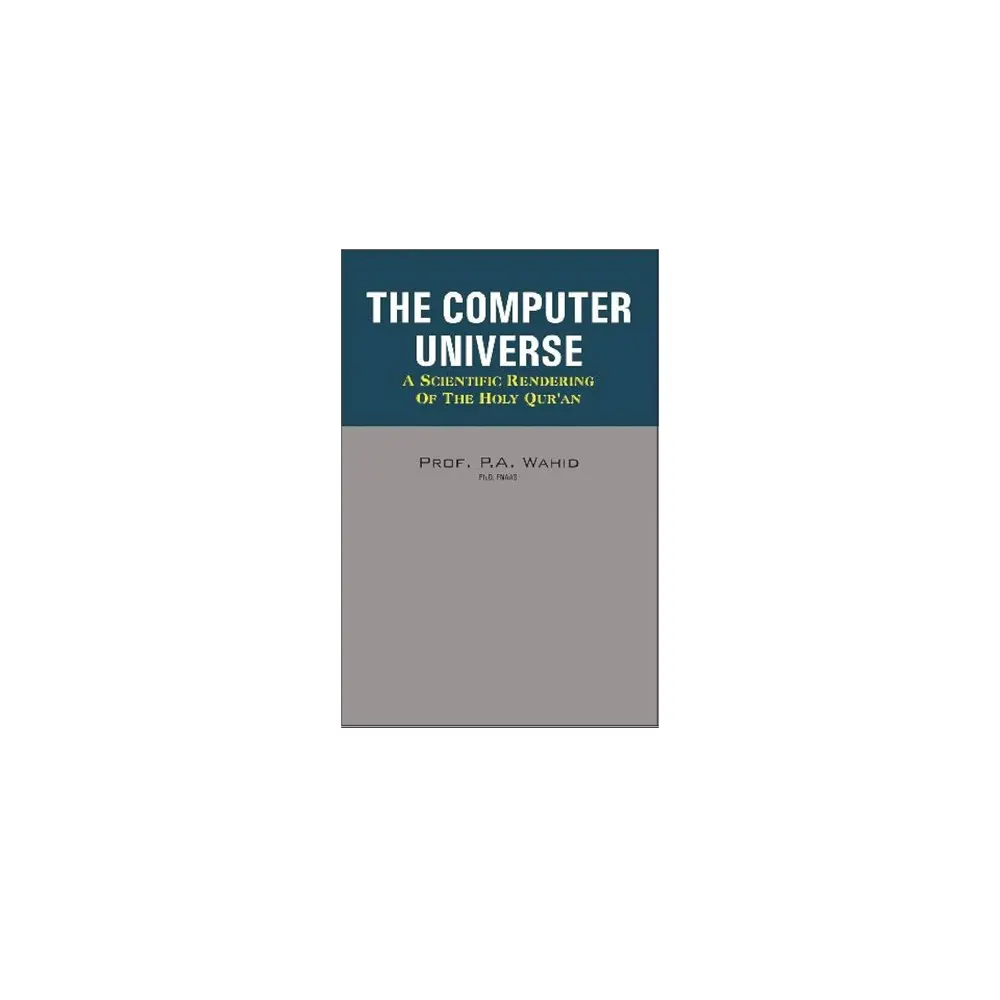
The Computer Universe A Scientific Rendering Of The Holy Quran (Prof. P.A. Wahid) Adam English

₹700.00
- The Quran as a Universal Algorithm
- A recurring metaphor in the book is the idea of the Quran as a “universal algorithm”:
- Just as an algorithm processes inputs to produce outputs, the Quran processes human understanding, guiding moral and spiritual growth.
- Its verses act like functions in a program, producing observable effects in thought, behavior, and society.
- The repetition of themes, emphasis on cause-and-effect relationships, and structural symmetry mirror computational processes.
- This metaphor underscores Wahid’s central thesis: divine wisdom is systematic, orderly, and accessible through both contemplation and empirical observation.
- 7. Critiques and Limitations
- While Wahid’s work is compelling, it is important to consider its limitations:
- Some interpretations of numerical patterns may be seen as subjective or speculative. Critics argue that humans naturally detect patterns, and some correlations might be coincidental.
- The computational metaphor, while illustrative, is not literal. The Quran is fundamentally a spiritual text, and not all scientific analogies fully capture its depth.
- The book presumes a harmony between Quranic guidance and modern science, which is convincing in some areas but not universally applicable in every detail of contemporary physics or biology.
Out of stock
The Computer Universe A Scientific Rendering Of The Holy Quran (Prof. P.A. Wahid) Adam English
Prof. P.A. Wahid’s The Computer Universe is an ambitious work that attempts to reconcile the eternal wisdom of the Holy Quran with the modern understanding of the universe, drawing upon scientific principles, mathematics, and computational concepts. Wahid’s approach is unique: he treats the Quran not only as a spiritual guide but also as a sophisticated framework containing patterns, structures, and laws that anticipate modern scientific discoveries. This explanation explores the key themes, methodology, and insights of the book.
1. The Quran and the Universe
Wahid begins with the premise that the Quran is a text of both spiritual and intellectual dimensions. He argues that the universe operates under precise laws and structures, and the Quran, as the word of God, encodes these principles. He likens the universe to a “computer,” where God is the ultimate programmer, and creation functions according to divine algorithms. Just as a computer processes information according to code, the universe functions systematically according to laws encoded by God.
The book emphasizes that science and religion need not be in conflict. Instead, the Quran provides guidance that complements empirical investigation. Verses discussing celestial bodies, the expansion of the universe, and the order of natural phenomena are presented as evidence that the Quranic worldview aligns with scientific principles discovered centuries later.
2. Mathematical and Computational Structure
A central feature of Wahid’s thesis is the mathematical elegance embedded in the Quran. He proposes that the Quranic text exhibits numerical patterns, symmetries, and ratios that are not coincidental but indicative of divine design. This includes concepts such as:
Numerical consistency: Certain words, letters, or phrases appear in the Quran with a frequency that matches significant numbers in nature or mathematics.
Binary-like structures: Some surahs (chapters) and ayahs (verses) demonstrate patterns reminiscent of computational logic, such as the use of opposites or paired concepts, which reflect dualities in the natural world (light/dark, life/death, matter/antimatter).
Geometric patterns: The arrangement of verses, thematic sequences, and structural repetitions in the Quran show a symmetry that mirrors patterns observed in nature, such as spirals, fractals, and symmetry in living organisms.
Wahid’s analogy treats the Quran as a sophisticated program: each verse is like a line of code, each surah a module, and the entire text functions as an integrated system conveying complex, multilayered truths.
3. The Concept of ‘Information’ in Creation
The book draws heavily on the idea of information theory, comparing the universe to a computational network. Wahid argues that:
Creation is information-driven, and physical laws act as protocols guiding the processing of matter and energy.
The Quran, in its precise structure and repeated themes, communicates information in a way that humans can decode and understand.
Just as a computer program is intelligible only if its syntax and logic are consistent, the Quran’s structure ensures that its spiritual, ethical, and scientific messages are coherent.
Through this lens, the universe itself becomes a text, and scientific inquiry becomes an effort to read and understand the divine “code” embedded in creation.
4. Scientific Correlations
Wahid meticulously draws parallels between Quranic verses and modern scientific findings:
Cosmology: Verses describing the heavens, the expansion of the universe, and the order of celestial bodies are interpreted in light of astrophysics and cosmology. For example, he connects Quranic references to the “heavens being joined and then separated” to the Big Bang theory and cosmic expansion.
Biology: References to the development of life, stages of embryogenesis, and the balance of ecosystems are discussed in connection with biology and genetics. Wahid suggests that the Quran’s descriptions are remarkably consistent with modern scientific observations.
Physics: Laws of motion, gravity, and the interplay of forces in nature are likened to Quranic references to divine order, balance, and harmony.
Importantly, Wahid does not claim that the Quran is a scientific textbook. Rather, he emphasizes that the Quran contains timeless truths that science gradually uncovers, demonstrating the coherence between divine wisdom and empirical observation.
5. Ethical and Philosophical Implications
Beyond scientific correlations, Wahid highlights the philosophical and ethical dimensions of seeing the universe as a computational system:
Humans are stewards of creation, and understanding the laws of the universe is a form of worship, reflecting our responsibility to maintain harmony.
Knowledge of natural laws should lead to ethical action, humility, and recognition of divine authority.
The Quran, with its structured and consistent message, provides a model for human cognition: logical, ethical, and spiritual reasoning are interdependent.
This approach bridges the perceived gap between rational inquiry and spiritual devotion, suggesting that science can enrich faith rather than undermine it.
6. The Quran as a Universal Algorithm
A recurring metaphor in the book is the idea of the Quran as a “universal algorithm”:
Just as an algorithm processes inputs to produce outputs, the Quran processes human understanding, guiding moral and spiritual growth.
Its verses act like functions in a program, producing observable effects in thought, behavior, and society.
The repetition of themes, emphasis on cause-and-effect relationships, and structural symmetry mirror computational processes.
This metaphor underscores Wahid’s central thesis: divine wisdom is systematic, orderly, and accessible through both contemplation and empirical observation.
7. Critiques and Limitations
While Wahid’s work is compelling, it is important to consider its limitations:
Some interpretations of numerical patterns may be seen as subjective or speculative. Critics argue that humans naturally detect patterns, and some correlations might be coincidental.
The computational metaphor, while illustrative, is not literal. The Quran is fundamentally a spiritual text, and not all scientific analogies fully capture its depth.
The book presumes a harmony between Quranic guidance and modern science, which is convincing in some areas but not universally applicable in every detail of contemporary physics or biology.
Despite these caveats, Wahid’s work opens a fruitful dialogue between science and spirituality, encouraging readers to explore the Quran with both intellect and faith.
8. Conclusion
The Computer Universe by Prof. P.A. Wahid is a groundbreaking attempt to synthesize the spiritual, ethical, and scientific dimensions of the Quran. It invites readers to view the universe as an orderly, information-driven system, designed with precision by God, and to see the Quran as a guide to understanding both spiritual truths and natural laws. By presenting the Quran as a “computational universe,” Wahid bridges faith and reason, suggesting that inquiry, reflection, and observation are complementary paths to knowledge.
The book ultimately inspires a holistic vision: humans are not just observers but participants in the divine design. Understanding the universe, following ethical principles, and seeking spiritual growth are intertwined processes that reflect the Quran’s multifaceted wisdom. Wahid’s work thus encourages a contemplative, scientifically informed faith, emphasizing that divine knowledge and empirical discovery are not opposites but two expressions of the same universal truth.
Only logged in customers who have purchased this product may leave a review.
Related Products

- Structure of the Edition
- 7-Line Arabic Text:
- The Quranic text is printed in 7 clear lines per page, allowing easy reading and maintaining flow for memorization.
- This layout supports progressive learning, enabling students to focus on smaller sections without feeling overwhelmed.
- Word-by-Word Meaning:
- Each Arabic word is accompanied by its literal meaning in Urdu.
- This facilitates direct comprehension, helping learners understand not only the recitation but also the message behind each verse.
- Tajweed Integration:
- Colour-coded or symbol-marked rules highlight correct pronunciation, elongation, nasalization, and stopping points.
- This ensures learners recite in line with classical Tajweed principles, maintaining accuracy in pronunciation and melody.
- Para Coverage:
- This edition covers Juz 1 to Juz 5, beginning from Surah Al-Fatiha to early parts of Surah Al-Ma’idah.
- It includes short Surahs and essential passages frequently used in Salah and recitation practice.
3 in stock
Benefits of Studying Para 2
- Spiritual Growth: Strengthens faith, patience, and reliance on Allah.
- Moral Guidance: Teaches honesty, justice, and social responsibility.
- Historical Insight: Provides lessons from prophets and past nations.
- Practical Life Guidance: Instructs on prayer, fasting, charity, and ethics.
- Preparation for the Hereafter: Encourages conscious living with accountability.
6 in stock

- Manzil Big M.M. Pickthal (Islami Kitab Ghar) English Arabic
- Significance of Manzil Big
- Spiritual Protection and Faith Reinforcement:
- Serves as a spiritual shield, reinforcing faith in Allah’s protection, mercy, and omnipotence.
- Comprehensive Guidance:
- Collects all essential protective verses, making it a complete reference for believers seeking daily spiritual practice.
- Facilitates Understanding:
- English translation allows non-Arabic speakers to comprehend and reflect on the Qur’ānic message, enhancing meaningful recitation.
- Encourages Regular Engagement with Qur’ān:
- Structured daily sections ensure that believers engage with the Qur’ān consistently, developing discipline, devotion, and spiritual awareness.
- Educational and Practical Utility:
- Serves as a tool for memorization, teaching, and spiritual instruction, making it suitable for schools, madrasas, and family use.
16 in stock

- The Holy Qur’An Colour Coded Tajweed Rules Ibs (Arabic)
- Ghunnah (Nasalization): Extended nasal sounds for Noon and Meem under certain conditions. The colour coding ensures learners sustain these sounds correctly.
- Ikhfa’ (Concealment): Noon Saakin or Tanween sounds are partially merged with following letters, producing a light nasal tone.
- Idgham (Merging): Letters are merged smoothly, either with Ghunnah (nasalized) or without, depending on the following letter.
- Iqlab (Conversion): Noon Saakin is transformed into a Meem sound when followed by a specific letter (Baa), producing a soft and blended recitation.
- Qalqalah (Echoing): Certain consonants produce a slight bounce when in Sukoon, and the colour helps learners anticipate the echo effect.
- Madd (Prolongation): Vowels are stretched for specific counts; different types of Madd (like natural, obligatory, or temporary) are highlighted using distinct colours.
- Rules of Noon and Meem Saakin: Various rules including Ikhfa’, Idgham, and Iqlab are visually reinforced, aiding both recognition and correct pronunciation.
- Other Articulation Rules: Proper tongue and lip positioning for letters, though not explicitly colour-coded, are often reinforced in accompanying guides or teacher instructions.
1 in stock

- Advantages of Lafz Ba Lafz Urdu Tarjuma
- Word-by-Word Accuracy: Connects Arabic words to precise Urdu meaning.
- Contextual Clarity: Combines literal translation with overall contextual understanding.
- Structured Learning: Supports stepwise study, memorization, and reflection.
- Spiritual and Ethical Engagement: Guides daily practice, moral behavior, and spiritual development.
- Educational Utility: Ideal for students, teachers, and researchers, bridging Arabic and Urdu understanding.
2 in stock
How to Use This Mushaf for Maximum Benefit
- Daily Recitation:
Allocate a set time for daily recitation. Focus on correct pronunciation, using the color-coded Tajweed rules as a guide. - Segmented Memorization:
Memorize small sections (e.g., a few verses or a page) before moving to the next. Use the verse numbers and Hizb divisions for systematic progress. - Repetition with Tajweed:
Recite repeatedly with attention to colors. For instance, pause and observe the letters marked for Ikhfa or Qalqalah until pronunciation is correct. - Record and Compare:
Advanced learners can record their recitation and compare with Tajweed rules to identify mistakes. - Teacher Feedback:
Regularly consult a teacher to correct subtle mistakes that color coding alone may not catch.
1 in stock

- The Noble Qur’An Tafseer-E-Usmani Shabbir Ahmed Usmani Idara (Arabic/English) 3 Volume Set
- Clear presentation of the Arabic Qur’ān with accurate English translation.
- Detailed commentary explaining linguistic, historical, theological, and legal aspects.
- Integration of classical scholarship with practical guidance for daily life.
- Structured, verse-by-verse approach supporting reflection, memorization, and study.
- Accessibility for a wide audience, from students to scholars and general readers
3 in stock
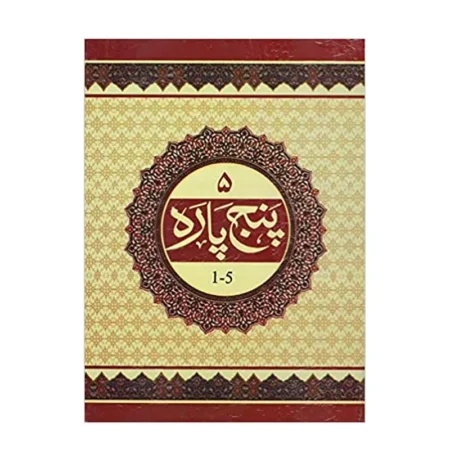
- Panj Para Set Sada 6 Vol (Idara) Arabic
- Practical Benefits
- Memorization (Hifz):
- Dividing the Quran into six volumes makes memorization easier.
- Learners can focus on one volume at a time, gradually covering the entire Quran.
- Daily Recitation:
- Reading one Para daily allows completion of the Quran in 30 days, promoting discipline and spiritual growth.
- Study and Teaching:
- Ideal for madrasas, Quran classes, or personal study.
- Teachers can assign specific volumes or Paras for recitation, Tajweed practice, or thematic discussion.
- Convenience and Durability:
- Compact size and sturdy binding make handling easy.
- Each volume is portable, suitable for home, school, or travel.
2 in stock

- The Holy Qur’An Colour Coded Tajweed Rules Ref. 3 Ibs (Arabic)
- Accurate and detailed colour-coded Tajweed rules.
- Uthmani Arabic script with clear diacritical marks.
- Coverage of both basic and advanced Tajweed principles.
- Practical support for memorization and daily recitation.
- Ease of use for self-study and classroom instruction.
2 in stock
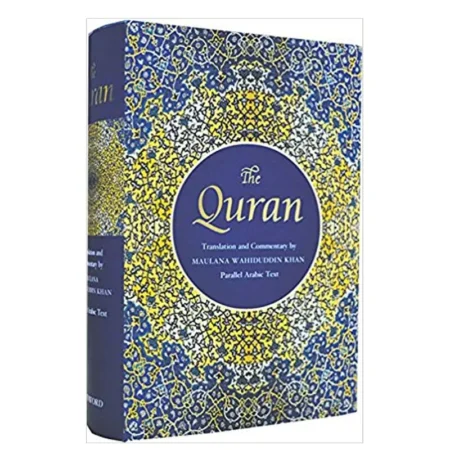
- Tazkeerul Quran ( Maulana Wahiduddin Khan ) Goodword Arabic/Hindi
- The central theme of Tazkeerul Quran is that the Qur’an is not merely a book of rituals, law, or theology, but a comprehensive guide for building a moral, ethical, and spiritually grounded life.
- Maulana Wahiduddin Khan stresses that the Qur’an addresses the human heart before it addresses human actions.
- It is concerned with shaping the inner self, which in turn manifests in ethical behavior, compassionate treatment of others, and a sense of accountability before God.
- This perspective underscores the Qur’an’s timeless relevance, showing that its message is universal and not confined to a specific culture, era, or society.
- The book also addresses the concept of human purpose and responsibility.
- Maulana Khan explains that the Qur’an presents life as a trust (Amanah) from God, and human beings are accountable for how they fulfill this trust.
- This idea encompasses not only individual ethical conduct but also the broader social and environmental responsibilities.
- The Qur’an encourages reflection, personal accountability, and the pursuit of knowledge to live a life aligned with divine guidance.
- Tazkeerul Quran highlights that spirituality in Islam is practical; it requires action rooted in moral consciousness, and mere ritual without inner transformation is insufficient.
2 in stock

- Conclusion
- Para 3-A of Al-Quran Ul Hakeem is a comprehensive guidance on faith, ethics, social justice, and spiritual development. It addresses:
- Ritual and spiritual obedience: Prayer, fasting, and sincerity in worship.
- Moral and ethical conduct: Honesty, humility, and social responsibility.
- Justice and accountability: Laws of retaliation, charity, and fair dealings.
- Reflection on history and divine signs: Learning from past nations and trusting in Allah’s wisdom.
- Inner faith vs. outward appearance: True belief is reflected in consistent, sincere action.
4 in stock
Benefits of Studying Para 3
- Spiritual Growth: Strengthens faith, reliance on Allah, and moral consciousness.
- Ethical Awareness: Enhances understanding of justice, honesty, and social responsibility.
- Historical Insight: Provides examples of prophetic guidance and lessons from past nations.
- Practical Life Guidance: Offers instructions on prayer, patience, and ethical living.
- Preparation for Accountability: Encourages awareness of the Hereafter and righteous conduct.
17 in stock
Reviews
There are no reviews yet.