
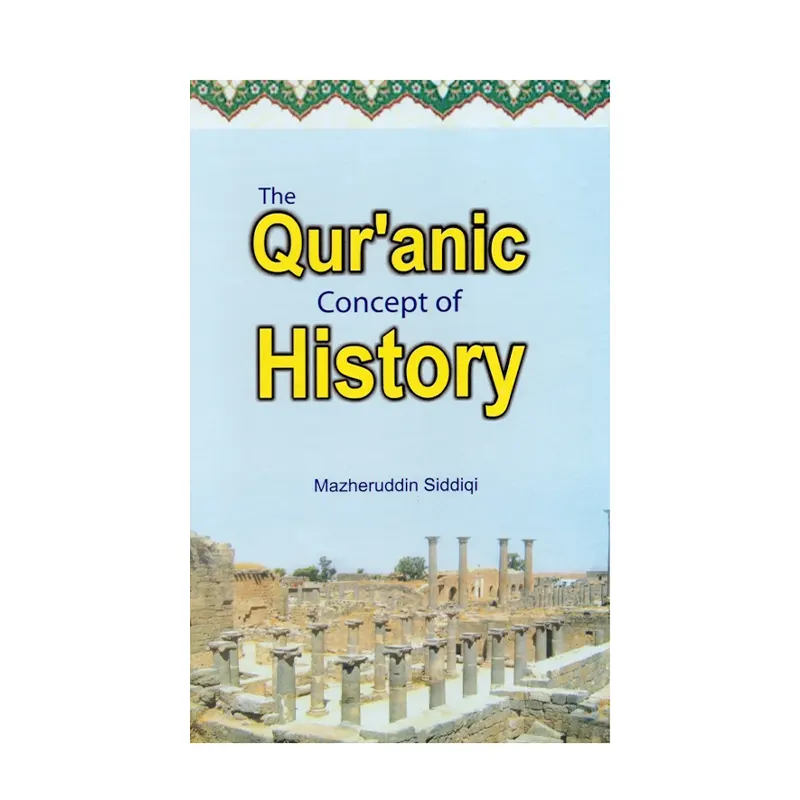
The Qur’Anic Concept Of History Mazheruddin Siddiqi Adam Publishers (English)


Original price was: ₹260.00.₹210.00Current price is: ₹210.00.
- The Qur’Anic Concept Of History Mazheruddin Siddiqi Adam Publishers (English)
- Purpose and Scope of the Book
- Understanding Qur’anic Historiography: Siddiqi examines how the Qur’an recounts events involving nations, prophets, and communities to convey moral, spiritual, and societal lessons.
- Ethical and Spiritual Focus: The Qur’anic concept of history stresses ethical guidance and the consequences of human actions, rather than mere political or military chronicles.
- Relevance for Contemporary Society: The book demonstrates that Qur’anic historical narratives remain relevant for modern challenges in morality, governance, and social justice.
- The work is intended for scholars, students, and anyone interested in Islamic history, theology, and philosophy.
- 2. The Nature of History in the Qur’an
- Divine Framework: History is presented as part of God’s plan, emphasizing divine wisdom, justice, and guidance. Events are interconnected with spiritual and ethical purposes.
- Cause and Consequence: Human actions—individual and collective—have moral consequences. Success and failure, prosperity and calamity, are often attributed to obedience or disobedience to divine guidance.
- History as a Teacher: The Qur’an invites reflection on past events to derive lessons, avoid mistakes, and cultivate ethical and spiritual awareness.
Out of stock
The Qur’Anic Concept Of History Mazheruddin Siddiqi Adam Publishers (English)
The Qur’anic Concept of History by Mazheruddin Siddiqi is a scholarly exploration of how the Qur’an approaches history, historical events, and the lessons derived from them. Unlike conventional historiography, which often focuses on chronological events or political narratives, the Qur’an presents history as a source of moral guidance, spiritual reflection, and understanding of divine wisdom. Siddiqi’s work emphasizes that history in the Qur’anic perspective is not merely a record of the past but a living lesson for humanity, connecting temporal events with ethical and theological dimensions.
1. Purpose and Scope of the Book
Understanding Qur’anic Historiography: Siddiqi examines how the Qur’an recounts events involving nations, prophets, and communities to convey moral, spiritual, and societal lessons.
Ethical and Spiritual Focus: The Qur’anic concept of history stresses ethical guidance and the consequences of human actions, rather than mere political or military chronicles.
Relevance for Contemporary Society: The book demonstrates that Qur’anic historical narratives remain relevant for modern challenges in morality, governance, and social justice.
The work is intended for scholars, students, and anyone interested in Islamic history, theology, and philosophy.
2. The Nature of History in the Qur’an
Divine Framework: History is presented as part of God’s plan, emphasizing divine wisdom, justice, and guidance. Events are interconnected with spiritual and ethical purposes.
Cause and Consequence: Human actions—individual and collective—have moral consequences. Success and failure, prosperity and calamity, are often attributed to obedience or disobedience to divine guidance.
History as a Teacher: The Qur’an invites reflection on past events to derive lessons, avoid mistakes, and cultivate ethical and spiritual awareness.
Siddiqi highlights that, for the Qur’an, history is pedagogical rather than purely descriptive.
3. The Role of Prophets in History
Messengers as Agents of Change: Prophets are central figures in Qur’anic history, guiding their communities toward moral and spiritual reform.
Historical Narratives of Prophets: Stories of Adam, Noah, Abraham, Moses, Jesus, and Muhammad (peace be upon them) illustrate struggles, divine support, and consequences of human choices.
Lessons from Prophetic History: Each narrative conveys universal values: patience, justice, faith, humility, courage, and reliance on God.
Prophets serve both as historical figures and as models for ethical and spiritual conduct.
4. Nations and Civilizations
Success and Decline: The Qur’an recounts the rise and fall of various nations—such as ‘Ad, Thamud, Pharaoh’s Egypt, and the people of Lot—as examples of moral and spiritual accountability.
Causes of Decline: Siddiqi emphasizes that deviation from ethical and divine guidance, corruption, arrogance, and injustice lead to societal collapse.
Universal Lessons: These narratives serve as cautionary tales for future generations, illustrating the consequences of collective human behavior.
The Qur’anic focus is less on geographical or political detail and more on ethical, spiritual, and societal patterns.
5. Time and History in the Qur’an
Cyclical and Progressive: History is presented as a dynamic continuum where lessons from the past inform present and future decisions.
Divine Perspective of Time: God’s knowledge encompasses all times, and events unfold according to divine wisdom.
Temporal Lessons: Humanity is encouraged to reflect on past events to ensure moral progress, ethical governance, and spiritual development.
Siddiqi stresses that understanding history in a Qur’anic sense requires perceiving both temporal events and their underlying moral dimensions.
6. Human Responsibility and Free Will
Moral Accountability: Individuals and communities are responsible for their actions; divine justice ensures consequences.
Role of Free Will: Human choice determines outcomes; history reflects the exercise of free will in obedience or defiance of God.
Ethical Dimension: Historical reflection in the Qur’an fosters ethical consciousness, promoting justice, compassion, and humility.
The book emphasizes that history is a moral mirror for human societies.
7. Lessons Derived from Qur’anic History
Patience in Adversity: Stories of prophets and their communities illustrate perseverance and reliance on God during trials.
Justice and Governance: The rise and fall of nations highlight the importance of ethical leadership, fairness, and societal responsibility.
Spiritual Awareness: Reflecting on past events cultivates consciousness of God’s presence and guidance in all aspects of life.
Social and Ethical Reform: Communities are encouraged to learn from historical mistakes and adopt moral and just practices.
Siddiqi argues that Qur’anic history is inherently instructive, shaping moral, social, and spiritual frameworks.
8. Comparison with Conventional Historiography
Focus on Meaning, Not Events: Conventional history often emphasizes dates, wars, and political changes, whereas Qur’anic history emphasizes ethical and spiritual lessons.
Integration of Ethics and Theology: Historical events are inseparable from moral and divine considerations.
Reflective Approach: The Qur’an encourages readers to engage critically and ethically with past events rather than merely memorize facts.
The book highlights the unique pedagogical and theological approach of Qur’anic historiography.
9. Contemporary Relevance
Guidance for Leadership: Lessons from history guide rulers, policymakers, and community leaders in ethical governance.
Moral Education: Individuals are encouraged to develop character, responsibility, and ethical awareness.
Social Reform: Qur’anic historical insights inspire reforms in justice, equality, and societal cohesion.
Reflection and Accountability: Modern societies are urged to learn from the mistakes and successes of past civilizations.
Siddiqi emphasizes that Qur’anic history is timeless, offering guidance for both personal and collective development.
10. Conclusion
The Qur’anic Concept of History by Mazheruddin Siddiqi:
Presents history as a divinely guided process with moral, spiritual, and ethical dimensions.
Highlights the lives of prophets, nations, and communities as sources of guidance.
Emphasizes the consequences of human choices, collective responsibility, and moral accountability.
Contrasts Qur’anic historiography with conventional history, showing its reflective, instructive, and spiritual focus.
Encourages contemporary readers to draw lessons, pursue ethical governance, and cultivate spiritual awareness.
Serves as a guide for moral, social, and intellectual development, demonstrating that history in the Qur’an is a living, instructive phenomenon.
The book underscores that history is not merely the record of events but a moral and spiritual teacher. By studying Qur’anic history, individuals and societies can understand divine wisdom, ethical responsibility, and the path to spiritual and social excellence.
| Weight | 250 g |
|---|---|
| Dimensions | 16 × 10 × 8 cm |
Only logged in customers who have purchased this product may leave a review.
Related Products
- Hayatus Sahaba Part -1 Hazrat Maulana Muhammad Yusuf Kandhalvi Idara (Urdu)
Overarching Themes Across All Three Volumes
- Faith and Conviction
The Sahaba were ordinary people transformed into extraordinary personalities because of their unshakable belief in Allah and the Prophet ﷺ. - Sacrifice and Struggle
They gave up wealth, family ties, and even their lives for Islam. Their sacrifices laid the foundation of the global Muslim Ummah. - Worship and Spirituality
Their strength came from constant connection with Allah through salah, Qur’an, and dhikr. - Simplicity and Humility
Despite wealth or authority, they lived simply and avoided arrogance. - Dawah and Responsibility
They understood Islam as a global message and considered it their duty to spread it everywhere. - Justice and Character
Their honesty, compassion, and fairness won people’s hearts more than any sword or wealth.
- Faith and Conviction
3 in stock

- By: Prof. A.M.A. Shushtery
Publisher: Adam Publishers
Paperback, 99 pages
2 in stock

- History Testifies To The Infallibility Of The Holy Qur’An Early History Of The Children Of Israel (Adam) English
1 in stock

- A History Of The Islamic Peoples S Khuda Bukhsh (Adam Publishers) English
- The Scope of the Book
- The book covers the following broad areas:
- The Rise of Islam and the Prophet Muhammad (PBUH):
- The book begins with the Arabian background – a description of pre-Islamic Arabia, its tribal structure, culture, social conditions, and religious practices.
- It then moves to the life of Prophet Muhammad (peace be upon him), his mission, the revelation of the Qur’an, the struggles in Makkah, migration to Madinah, and the establishment of the first Islamic state.
- The author emphasizes how Islam brought moral, social, and spiritual reforms to a region deeply divided by tribalism and superstition.
- The Rashidun Caliphate (632–661 CE):
- Khuda Bukhsh describes the leadership of the four rightly guided caliphs (Abu Bakr, Umar, Uthman, Ali).
- He highlights the rapid expansion of Islam beyond Arabia into Syria, Iraq, Egypt, and Persia.
- Important administrative and legal reforms introduced by Caliph Umar are explained.
- The internal conflicts, especially during the caliphate of Uthman and Ali, are presented in a balanced way.
- The Umayyad Caliphate (661–750 CE):
- The book outlines the transformation of the caliphate into a hereditary monarchy under Muawiyah.
- It explains the expansion into North Africa, Spain (Andalusia), and Central Asia.
- Khuda Bukhsh also discusses the administrative centralization and cultural flowering of Damascus, the Umayyad capital.
2 in stock
- Irshaadul Mulook Shaykh Aashiq Ilaahi Merathi (Adam) English
1 in stock

- Mercy For Mankind Rahmatul-Lil-Alamin Qazi Sulaiman Mansoorpuri (Adam) English
1 in stock

- A Comparative Study Of Christianity & Islam By Ulfat Azizus Samad (Adam Publishers) English
1 in stock

- Islam Muslims And Non-Muslims Yusuf Alqarazavi (Adam) English
1 in stock

- Islam Christianity And Judaism Moid Siddiqui (Adam) English
1 in stock

- Hayatus Sahaba Part -3 Hazrat Maulana Muhammad Yusuf Kandhalvi Idara (Urdu)
Conclusion
Hayatus Sahaba Part 3 by Hazrat Maulana Muhammad Yusuf Kandhalvi (RA) completes the journey of the Sahaba’s lives by showing how they carried Islam to the world.
- It records their dawah efforts, their bravery in jihad, their sacrifices, and their role as just and compassionate leaders.
This volume is not just a history of expansion; it is a blueprint for Muslim life and responsibility. It teaches that:
- Islam is not private—it is a universal mission.
- Sacrifice and struggle are necessary for spreading truth.
- Justice, honesty, and compassion are the foundation of Islamic influence.
- Ordinary people, with extraordinary faith, can change the course of history.
1 in stock

- Europe’S Gift To Islam Vol 1&2 Muhammad Asad (Adam) English
1 in stock
- The Prophetic Medical Science Shamsuddin Mohammed Ibn Qayyim Al-Jawziyya Idara (English)
- Purpose and Scope of the Book
- Preservation of Health in Islam: The book aims to highlight how Islam promotes personal hygiene, healthy living, and disease prevention.
- Spiritual and Ethical Integration: Prophetic medicine is not just physical; it incorporates mental and spiritual health.
- Practical Guidance: Offers remedies, preventive measures, and dietary recommendations that are relevant for contemporary readers.
- Educational Resource: Serves scholars, students, healthcare professionals, and anyone interested in the intersection of medicine and Islamic guidance.
- The book emphasizes that health is a divine trust and that human beings have a responsibility to care for their bodies and souls.
- 2. Concept of Health in Prophetic Medicine
- Holistic Approach: Health encompasses physical, mental, and spiritual well-being. A balanced lifestyle ensures harmony among body, mind, and soul.
- Preventive Care: Emphasizes diet, cleanliness, exercise, and moderation as primary means of disease prevention.
- Spiritual Health: Strong faith, prayer, gratitude, and ethical conduct are considered essential for overall well-being.
- Natural Remedies: The Prophet recommended natural substances like honey, black seed (Nigella sativa), dates, olive oil, and water for healing and maintenance of health.
1 in stock
Reviews
There are no reviews yet.