
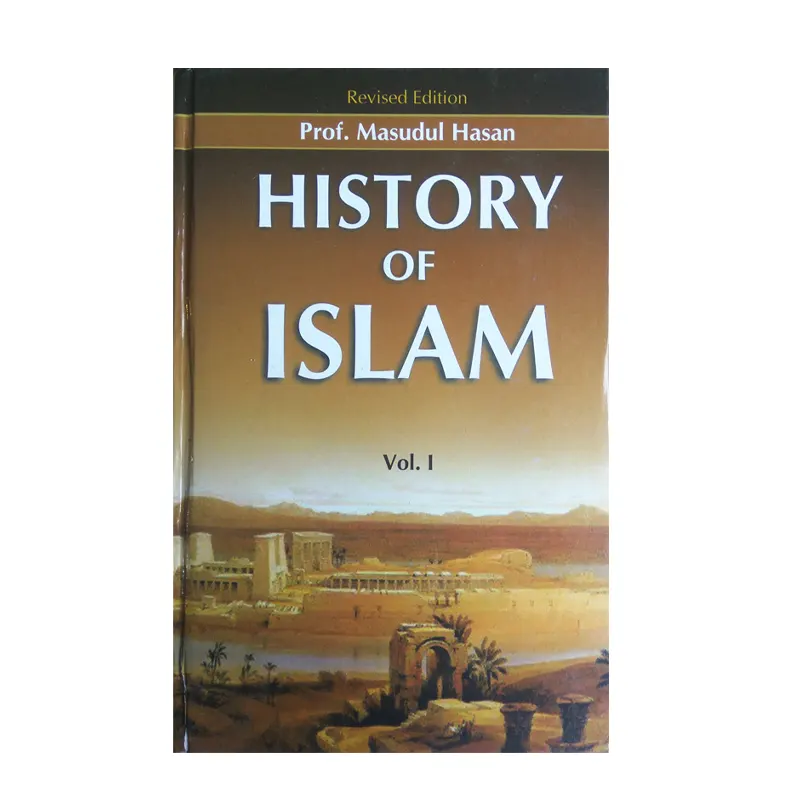
History Of Islam Prof Masudul Hasan 2 Vol (Adam) English


Original price was: ₹1,295.00.₹1,050.00Current price is: ₹1,050.00.
- History Of Islam Prof Masudul Hasan 2 Vol (Adam) English
- The life of Prophet Muhammad ﷺ and the foundation of the Islamic state.
- The period of the Rightly Guided Caliphs (Rashidun).
- The Umayyad and Abbasid dynasties, their administrative achievements, and cultural contributions.
- The spread of Islam to different regions and its interaction with diverse cultures.
- Intellectual, scientific, and religious developments in the Muslim world.
Out of stock
History Of Islam Prof Masudul Hasan 2 Vol (Adam) English
Introduction
History of Islam by Prof. Masudul Hasan is a comprehensive two-volume work that chronicles the development of Islam from its inception in the 7th century CE to its socio-political, cultural, and intellectual evolution across the centuries. The book presents a balanced combination of historical facts, socio-political analysis, and discussion of Islamic thought, making it accessible to both students and general readers.
The two volumes collectively cover:
The life of Prophet Muhammad ﷺ and the foundation of the Islamic state.
The period of the Rightly Guided Caliphs (Rashidun).
The Umayyad and Abbasid dynasties, their administrative achievements, and cultural contributions.
The spread of Islam to different regions and its interaction with diverse cultures.
Intellectual, scientific, and religious developments in the Muslim world.
Prof. Hasan emphasizes not only political history but also social, economic, and intellectual history, portraying Islam as a dynamic civilization.
Volume 1 – Early Islam and the Rashidun Caliphate
1. Life of Prophet Muhammad ﷺ
Early Life: Born in Makkah in 570 CE, Prophet Muhammad ﷺ faced early hardship, losing his parents young.
Prophethood: At age 40, he received revelation, marking the beginning of Islam. His mission emphasized monotheism, social justice, and moral reform.
Persecution and Migration: Early Muslims faced oppression from Quraysh elites. The migration (Hijrah) to Madinah in 622 CE marked the establishment of the first Islamic state.
Madinah State: The Prophet ﷺ established a model society based on justice, consultation (Shura), and welfare.
Military Campaigns: Battles of Badr, Uhud, and Khandaq were defensive yet instrumental in consolidating the Muslim community.
Lesson: Islam emerged not only as a faith but as a socio-political system emphasizing justice, ethics, and communal solidarity.
2. Rashidun Caliphate (632–661 CE)
After the Prophet’s ﷺ death, the Rashidun Caliphs led the Muslim community.
Abu Bakr Siddiq (RA): Preserved the unity of Muslims during the Ridda (apostasy) wars and compiled the Qur’an into a single manuscript.
Umar ibn al-Khattab (RA): Expanded the Islamic empire to Persia, Syria, and Egypt, established justice systems, public welfare, and administrative structures.
Uthman ibn Affan (RA): Standardized the Qur’an, oversaw conquests, and promoted public works.
Ali ibn Abi Talib (RA): Known for his knowledge, justice, and courage; faced internal strife like the Battle of Camel and Siffin.
Lesson: Leadership during early Islam balanced expansion, governance, and justice, setting benchmarks for future rulers.
3. Social and Economic Life
Prof. Hasan emphasizes that Islam revolutionized social and economic norms:
Social Justice: Rights for women, orphans, and the poor were institutionalized.
Economic Reform: Zakat system ensured wealth redistribution, and trade was conducted ethically.
Education: Religious and worldly knowledge were encouraged, laying foundations for later intellectual achievements.
Volume 2 – Umayyad, Abbasid, and Later Islamic Civilization
1. Umayyad Dynasty (661–750 CE)
Administration and Expansion: The Umayyads established a strong centralized administration, extended Islamic rule to Spain, North Africa, and Central Asia.
Cultural Integration: Arabic became the administrative language, and Islamic law began codification.
Challenges: Political centralization created dissent, but the dynasty laid the foundation for a pan-Islamic empire.
2. Abbasid Dynasty (750–1258 CE)
Golden Age of Islam: The Abbasid era marked significant achievements in science, philosophy, literature, and art.
Baghdad as a Cultural Center: The city became a hub of learning, housing the House of Wisdom (Bayt al-Hikmah), translating Greek, Persian, and Indian works.
Economic Prosperity: Trade flourished, connecting Asia, Africa, and Europe.
Religious Thought: Development of fiqh (Islamic jurisprudence), theology, and philosophy thrived. Thinkers like Al-Farabi, Al-Ghazali, and Ibn Sina emerged.
Lesson: The Abbasid period demonstrates the integration of faith, knowledge, and governance, producing a globally influential civilization.
3. Regional Expansion and Cultural Impact
Spread to Africa and Asia: Islam reached West Africa, India, and Southeast Asia, often through trade and missionary activity (dawah).
Cultural Synthesis: Islamic civilization adapted to local cultures while retaining core religious principles, fostering literature, architecture, and educational institutions.
Military Campaigns: Strategic and often defensive campaigns protected the Islamic territories and facilitated safe trade and cultural exchange.
4. Intellectual and Scientific Contributions
Prof. Hasan emphasizes the role of Muslim scholars in:
Mathematics and Astronomy: Innovations like algebra, trigonometry, and astronomical tables.
Medicine: Hospitals, pharmacology, and medical ethics advanced human health.
Philosophy and Theology: Muslim philosophers reconciled reason with faith, influencing Europe through translations.
Literature and Art: Poetry, calligraphy, and architecture flourished, reflecting spiritual and aesthetic sophistication.
Overarching Themes Across Both Volumes
Integration of Faith and Reason: Islam promoted intellectual inquiry while upholding spiritual values.
Justice and Governance: Ethical governance was central, balancing expansion with social welfare.
Expansion through Trade and Missionary Work: Islam spread through both peaceful means and military strategy.
Civilizational Contribution: Muslim civilization contributed globally in science, philosophy, art, and social reform.
Continuity and Adaptation: Islamic governance and culture evolved to address changing socio-political contexts while preserving core principles.
Relevance Today
Ethical Leadership: Prof. Hasan’s work illustrates the importance of justice, accountability, and humility in governance.
Education and Knowledge: Emphasizes lifelong learning, critical inquiry, and integration of scientific and religious knowledge.
Social Welfare: Highlights Islam’s focus on caring for marginalized communities.
Global Civilization: Shows how Islamic principles can coexist with cultural diversity and contribute positively to world civilization.
Conclusion
History of Islam by Prof. Masudul Hasan provides a comprehensive and nuanced account of the development of Islam from the Prophet’s ﷺ life to the medieval Islamic civilization.
Volume 1: Covers early Islam, the Prophet’s mission, and the Rashidun Caliphate, emphasizing faith, justice, and social reform.
Volume 2: Focuses on the Umayyad and Abbasid dynasties, highlighting expansion, cultural synthesis, and intellectual achievements.
The two volumes collectively demonstrate that Islam is not merely a religion but a civilization encompassing spiritual, social, political, and intellectual dimensions. Prof. Hasan’s scholarly work provides readers with a balanced understanding of Islam’s historical trajectory and its enduring contributions to humanity.
Key Takeaways:
Islam integrates faith, law, ethics, and knowledge.
Leadership and governance are inseparable from justice and public welfare.
Muslim civilization flourished by synthesizing diverse cultural and intellectual traditions.
The historical legacy of Islam offers guidance for modern challenges in governance, education, and social reform.
| Weight | 350 g |
|---|---|
| Dimensions | 16 × 10 × 8 cm |
Only logged in customers who have purchased this product may leave a review.
Related Products
- Irshaadul Mulook Shaykh Aashiq Ilaahi Merathi (Adam) English
1 in stock

- Tarikh-E-Islam Akbar Shah Khan Najibabadi Al Hasanat (Hindi) 2 Volume Set
- Key Takeaways:
- Islam emerged in a challenging socio-political environment and transformed Arabian society through spiritual and ethical teachings.
- Prophet Muhammad’s (PBUH) leadership combined moral integrity, diplomacy, and strategic acumen.
- The Rashidun Caliphs laid the foundations of governance, justice, and expansion that shaped early Islamic history.
- Umayyad and Abbasid dynasties contributed to political consolidation and cultural flourishing.
- Islamic history provides timeless lessons in leadership, justice, morality, and social responsibility.
- Historical reflection is essential for understanding both the successes and pitfalls of past Muslim societies.
2 in stock
Key Themes and Analysis
1. Administrative Changes Under Mughal Rule
2. Socio-Cultural Transformations
3. Economic Developments
4. Decline of Mughal Influence and Rise of Maratha Power
5. British Colonial Encroachment
1 in stock

- By: Prof. A.M.A. Shushtery
Publisher: Adam Publishers
Paperback, 99 pages
2 in stock
- Hayatus Sahaba Part -1 Hazrat Maulana Muhammad Yusuf Kandhalvi Idara (Urdu)
Overarching Themes Across All Three Volumes
- Faith and Conviction
The Sahaba were ordinary people transformed into extraordinary personalities because of their unshakable belief in Allah and the Prophet ﷺ. - Sacrifice and Struggle
They gave up wealth, family ties, and even their lives for Islam. Their sacrifices laid the foundation of the global Muslim Ummah. - Worship and Spirituality
Their strength came from constant connection with Allah through salah, Qur’an, and dhikr. - Simplicity and Humility
Despite wealth or authority, they lived simply and avoided arrogance. - Dawah and Responsibility
They understood Islam as a global message and considered it their duty to spread it everywhere. - Justice and Character
Their honesty, compassion, and fairness won people’s hearts more than any sword or wealth.
- Faith and Conviction
3 in stock

- The Alhambra Washington Irving (Goodword) English
- Key Takeaways:
- Islam emerged in a challenging socio-political environment and transformed Arabian society through spiritual and ethical teachings.
- Prophet Muhammad’s (PBUH) leadership combined moral integrity, diplomacy, and strategic acumen.
- The Rashidun Caliphs laid the foundations of governance, justice, and expansion that shaped early Islamic history.
- Umayyad and Abbasid dynasties contributed to political consolidation and cultural flourishing.
- Islamic history provides timeless lessons in leadership, justice, morality, and social responsibility.
- Historical reflection is essential for understanding both the successes and pitfalls of past Muslim societies.
1 in stock
- Physics Technology And Civilization M Rafat (Adam) English
1 in stock

- Islam Christianity And Judaism Moid Siddiqui (Adam) English
1 in stock

- Minhaj Et Talibin A Manual Of Muhammadan Law M. Abu Zakaria Yahya Ibn Sharif En Nawawi Aadam Publishers (English)
1 in stock
- Islam On Science And Technology Dr. A Rahman Adam Publishers (English)
1 in stock

- A Comparative Study Of Christianity & Islam By Ulfat Azizus Samad (Adam Publishers) English
1 in stock

- Mercy For Mankind Rahmatul-Lil-Alamin Qazi Sulaiman Mansoorpuri (Adam) English
1 in stock
Reviews
There are no reviews yet.