
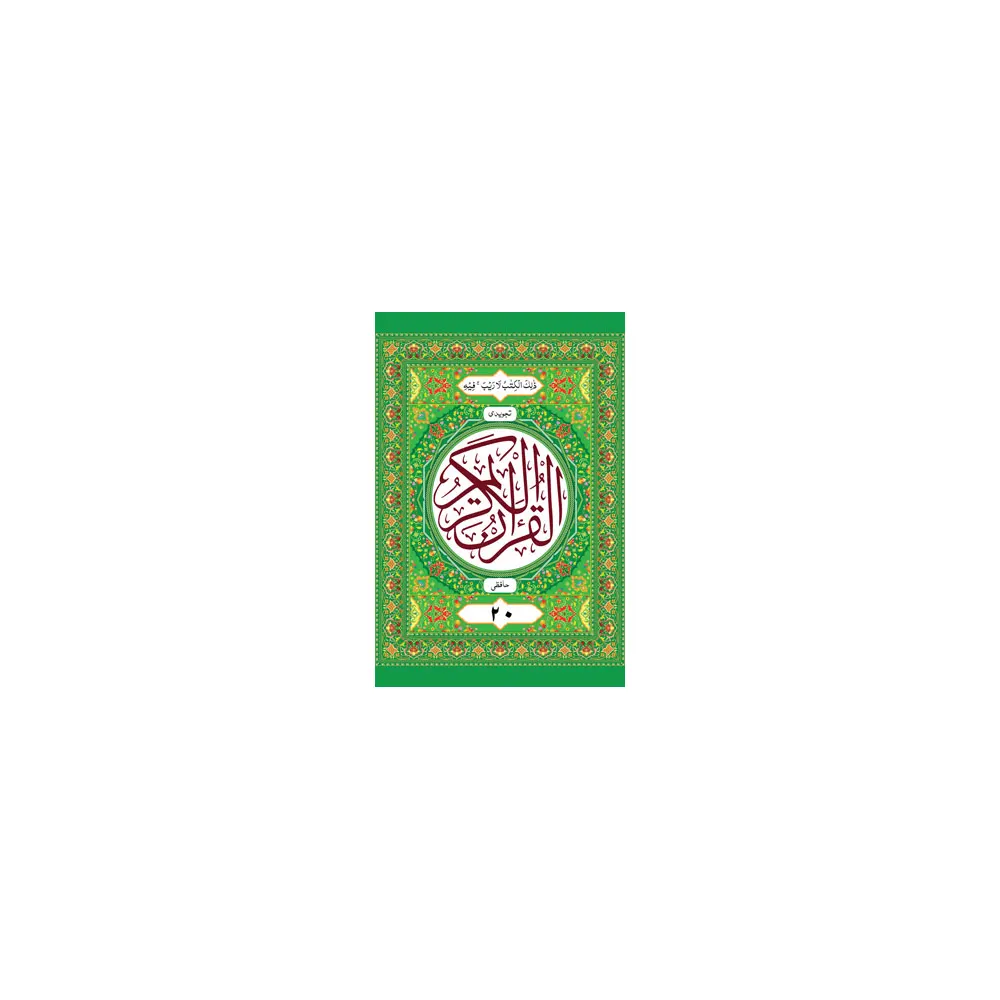
Parah No-20
₹10.00
- Conclusion
- Parah No. 20 of the Quran is a powerful blend of spiritual guidance, ethical teachings, and historical lessons. Its key messages include:
- Faith in Allah and obedience to His commands.
- Patience, perseverance, and moral courage, inspired by the Prophets.
- Awareness of the Hereafter, fostering accountability and responsibility.
- Social ethics and justice, reflected in collective worship, leadership, and protection of rights.
- Reflection on divine signs and history, encouraging wisdom and moral vigilance.
Out of stock
Parah No-20
Introduction
Parah No. 20 of the Quran covers Surah Al-Anbiya (21:1–112), Surah Al-Hajj (22:1–78). This Parah emphasizes the role of Prophets, accountability, divine signs, the Hereafter, and social guidance. It is a bridge between moral lessons from past communities and practical instructions for believers, highlighting faith, patience, and submission to Allah.
1. Key Themes of Parah No. 20
A. Prophethood and Guidance (21:1–112)
The Purpose of Prophets
Allah sent Prophets as guides for humanity, to warn against idolatry and injustice and to lead people to truth and righteousness.
Prophets like Noah, Abraham, Moses, and Muhammad (peace be upon them) are mentioned as exemplars of steadfastness, devotion, and moral courage.
Challenges Faced by Prophets
The Parah highlights the opposition and ridicule faced by Prophets from their communities.
Despite adversity, Prophets remained patient, relied on Allah, and persisted in delivering the divine message (21:25–32).
Miracles and Divine Signs
Allah sent clear signs and miracles to support His Prophets, demonstrating His power and validating their message.
Believers are encouraged to reflect on these signs to strengthen their faith.
Accountability and Consequences
The Quran recounts the fate of past nations who rejected their Prophets (e.g., people of Noah, Hud, Salih, and Lot).
Disobedience led to divine punishment, while obedience and faith brought mercy and salvation (21:47–70).
B. Emphasis on Monotheism and Worship
The Parah emphasizes pure monotheism (Tawheed) and warns against idol worship and polytheism.
Believers are instructed to worship Allah alone, submit sincerely, and avoid false deities (21:92–94).
Tawheed is not just belief; it manifests in ethical conduct, justice, and community responsibility.
C. The Day of Judgment and Accountability (21:47–112)
Weighing of Deeds (Mizan)
Every action will be measured on the Day of Judgment, and no good or bad deed is overlooked (21:47).
Justice will be perfect, ensuring that everyone receives what they deserve.
Reward and Punishment
Believers who remain steadfast will be rewarded with paradise, while those who deny and reject guidance will face punishment in Hellfire.
The Parah stresses personal responsibility: each person is accountable for their faith, choices, and actions.
Signs of the Hereafter
The Quran uses natural phenomena and human experiences as signs of the Day of Judgment.
Reflection on these signs strengthens faith and encourages moral and spiritual awareness.
D. Surah Al-Hajj (22:1–78) – Pilgrimage, Worship, and Obedience
The Importance of Hajj (22:27–37)
The Parah introduces guidance on the Hajj pilgrimage, one of the pillars of Islam.
Hajj is a unifying act of worship, symbolizing submission, equality, and remembrance of Allah.
Sacrifice and Ethical Worship
Rituals such as sacrifice are symbolic of obedience and devotion, not mere tradition.
Believers are reminded to act sincerely and ethically, avoiding arrogance or ritualism devoid of understanding.
Guidance for Social Conduct (22:39–41)
Believers are permitted to defend themselves but must maintain justice.
Ethical governance, fairness in conflict, and protection of rights are emphasized.
Monotheism and Avoiding Idolatry (22:30–31)
Believers are reminded to stay firm in Tawheed, reflecting that worship is a combination of faith, action, and moral responsibility.
Reflection and Gratitude (22:36–38)
Allah reminds believers to reflect on His blessings, remain humble, and maintain gratitude in every aspect of life.
Gratitude manifests in worship, social responsibility, and ethical living.
2. Spiritual Lessons from Parah No. 20
Patience and Perseverance
Like the Prophets, believers must remain patient in the face of trials, ridicule, or opposition.
Endurance and reliance on Allah are keys to spiritual growth.
Ethical Monotheism (Tawheed in Action)
Worship is incomplete without justice, fairness, and ethical conduct.
True belief transforms both personal and societal behavior.
Awareness of the Hereafter
Constant reflection on life, death, and accountability motivates ethical and spiritual behavior.
Understanding that deeds are measured ensures responsibility in all actions.
Unity and Social Harmony
Hajj and other collective rituals symbolize equality, fraternity, and mutual respect among believers.
Community cohesion is strengthened through shared worship, ethical conduct, and fairness.
Learning from History
The stories of past Prophets and nations serve as lessons, illustrating the consequences of belief and disbelief.
Reflection on history helps avoid mistakes and encourages moral vigilance.
3. Practical Applications for Modern Life
Personal Spirituality
Regular worship, reflection, and ethical living.
Awareness of accountability in daily actions.
Community Responsibility
Upholding justice, fairness, and social cohesion.
Protecting vulnerable groups and maintaining societal harmony.
Learning from Prophetic Examples
Emulate patience, perseverance, and moral courage.
Follow guidance for both individual and collective well-being.
Pilgrimage and Remembrance
Hajj teaches equality, humility, and devotion, applicable as a mindset beyond rituals.
Ethical Leadership and Defense
Leadership and defense should be just, ethical, and aligned with divine principles.
4. Conclusion
Parah No. 20 of the Quran is a powerful blend of spiritual guidance, ethical teachings, and historical lessons. Its key messages include:
Faith in Allah and obedience to His commands.
Patience, perseverance, and moral courage, inspired by the Prophets.
Awareness of the Hereafter, fostering accountability and responsibility.
Social ethics and justice, reflected in collective worship, leadership, and protection of rights.
Reflection on divine signs and history, encouraging wisdom and moral vigilance.
By internalizing the teachings of Parah No. 20, believers cultivate a life of balance, righteousness, and spiritual depth, prepared for both worldly challenges and the eternal Hereafter.
Only logged in customers who have purchased this product may leave a review.
Related Products

- Personal Use: Ideal for daily recitation and personal study.
- Educational: Suitable for students of Quranic recitation and memorization.
- Gift: A thoughtful and meaningful gift for friends, family, or loved ones.
- Always handle the Mushaf with clean hands (wudu).
- Keep it inside its golden purse case when not in use.
- Avoid placing it on the floor or beneath other items.
- Do not expose it to direct sunlight or moisture.
- For frequent travelers, carry it in the purse to ensure safety and respect.
2 in stock

- Juz’U ‘Amma Cc ( Ibs ) Arabic
- Content Overview
- Juz‘U ‘Amma consists of 37 short Surahs (78–114). Though short in length, each Surah delivers powerful guidance, warnings, and hope, encapsulating the essence of Islamic teachings.
- 1. Themes of the Surahs
- Belief in Allah and the Hereafter:
Surahs repeatedly remind humans of Allah’s power, creation, and judgment, e.g., Surah An-Naba emphasizes resurrection and accountability. - Warnings against disbelief and arrogance:
Stories of past nations and their rejection of prophets (Surah Al-Mursalat, Al-Infitar) illustrate the consequences of ignoring divine guidance. - Moral and ethical guidance:
Surahs like Al-Adiyat and Al-Qari‘ah highlight justice, honesty, and awareness of divine judgment. - Praise of Allah and reflection on creation:
Surahs encourage humans to reflect on natural phenomena, the cosmos, and signs of Allah, fostering gratitude and humility. - Seeking protection and guidance:
Surahs Al-Falaq and An-Nas teach supplication, reliance on Allah, and seeking refuge from evil.
3 in stock
- The translation is written in plain, everyday Urdu, avoiding difficult or archaic vocabulary.
- Each verse is translated in a smooth, natural flow so that even readers with limited Arabic knowledge can grasp the message.
- The translator’s focus is on faithful rendering of meaning, not word-for-word literalism.
- When necessary, parenthetical clarifications or short explanatory notes are provided to convey nuances that would otherwise be lost in translation.
- This translation emphasizes the universal guidance of the Qur’an—its message of oneness of God, accountability in the Hereafter, moral purity, and social justice.
- The commentary highlights key Qur’anic concepts such as Tawheed (monotheism), Risalah (prophethood), and Akhirah (the Hereafter).
1 in stock

- In The Shade Of The Holy Qur’An Sayyid Qutb Vol.30 Idara (English)
- Significance of Volume 30
- Concluding Lessons of the Qur’ān:
- The final surahs emphasize spiritual purity, ethical conduct, gratitude, and divine reliance, summarizing the core moral and spiritual messages.
- Accessible for Daily Reflection:
- Short, powerful surahs make this volume ideal for meditation, memorization, and application in daily life.
- Bridging Traditional and Modern Understanding:
- Sayyid Qutb’s tafsīr links classical meanings with contemporary human challenges, making it relevant for modern readers.
- Strengthening Faith and Moral Character:
- Encourages readers to internalize faith, uphold moral principles, and maintain ethical behavior in all aspects of life.
2 in stock

- Riyazul Quran 30 Para Set Ibs (Arabic)
- Structure and Features
- Arabic Text (Uthmani Script)
- Complete Qur’an in authentic Uthmani script.
- Includes ayah numbering, Surah headings, and Ruku markers.
- Full diacritics for accurate pronunciation and Tajweed practice.
- Division into 30 Para (Juz’)
- Traditional division enables structured recitation.
- Each Para can be recited daily to complete the Qur’an in a month.
- Useful for memorization and review.
- Readable Layout
- Clear font and balanced spacing for comfortable reading.
- Suitable for adults, students, and older children.
- Durable and Practical
- Each Para is bound individually or as part of a full set, making it easy to handle and use regularly.
- Sturdy binding ensures frequent recitation without wear.
- Optional Features
- Some editions may include tables, page numbers, or Surah index.
- Can be integrated with Tajweed books or Arabic learning resources.
2 in stock

- The Holy Qur’An Colour Coded Tajweed Rules Ibs (Arabic)
- Ghunnah (Nasalization): Extended nasal sounds for Noon and Meem under certain conditions. The colour coding ensures learners sustain these sounds correctly.
- Ikhfa’ (Concealment): Noon Saakin or Tanween sounds are partially merged with following letters, producing a light nasal tone.
- Idgham (Merging): Letters are merged smoothly, either with Ghunnah (nasalized) or without, depending on the following letter.
- Iqlab (Conversion): Noon Saakin is transformed into a Meem sound when followed by a specific letter (Baa), producing a soft and blended recitation.
- Qalqalah (Echoing): Certain consonants produce a slight bounce when in Sukoon, and the colour helps learners anticipate the echo effect.
- Madd (Prolongation): Vowels are stretched for specific counts; different types of Madd (like natural, obligatory, or temporary) are highlighted using distinct colours.
- Rules of Noon and Meem Saakin: Various rules including Ikhfa’, Idgham, and Iqlab are visually reinforced, aiding both recognition and correct pronunciation.
- Other Articulation Rules: Proper tongue and lip positioning for letters, though not explicitly colour-coded, are often reinforced in accompanying guides or teacher instructions.
10 in stock

- The Noble Qur’An Tafseer-E-Usmani Shabbir Ahmed Usmani Idara (Arabic/English) 3 Volume Set
- Clear presentation of the Arabic Qur’ān with accurate English translation.
- Detailed commentary explaining linguistic, historical, theological, and legal aspects.
- Integration of classical scholarship with practical guidance for daily life.
- Structured, verse-by-verse approach supporting reflection, memorization, and study.
- Accessibility for a wide audience, from students to scholars and general readers
1 in stock
- Conclusion
- Para 23 of the Qur’an (23:1 – 25:20) is a comprehensive guide on morality, faith, and accountability. It emphasizes:
- Believers’ qualities: humility, prayer, chastity, honesty, and charity.
- Consequences of disobedience: historical lessons and divine justice.
- Divine signs in creation: reflection and gratitude strengthen faith.
- Guidance through the Qur’an: distinguishing truth from falsehood.
- Preparation for the Hereafter: ultimate success depends on faith and righteous deeds.
1 in stock
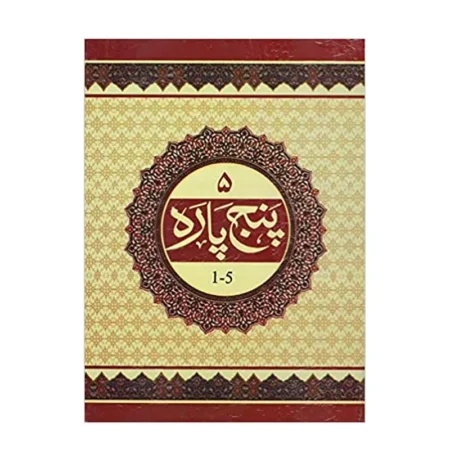
- Panj Para Set Sada 6 Vol (Idara) Arabic
- Practical Benefits
- Memorization (Hifz):
- Dividing the Quran into six volumes makes memorization easier.
- Learners can focus on one volume at a time, gradually covering the entire Quran.
- Daily Recitation:
- Reading one Para daily allows completion of the Quran in 30 days, promoting discipline and spiritual growth.
- Study and Teaching:
- Ideal for madrasas, Quran classes, or personal study.
- Teachers can assign specific volumes or Paras for recitation, Tajweed practice, or thematic discussion.
- Convenience and Durability:
- Compact size and sturdy binding make handling easy.
- Each volume is portable, suitable for home, school, or travel.
2 in stock
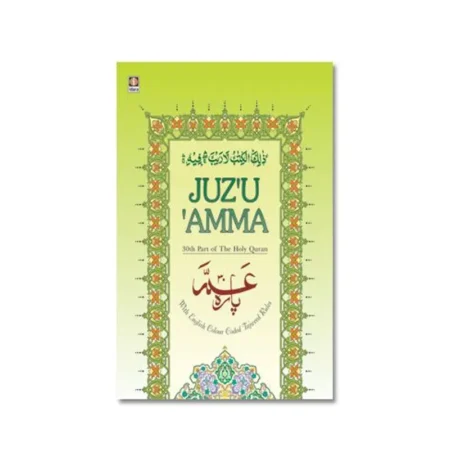
- Juzu ‘Amma Idara (Arabic)
- Significance of Juz’ Amma
- Entry Point for Qur’ānic Learning:
- Often the first section taught to children and beginners, providing a foundation for understanding the Qur’ān.
- Memorization-Friendly:
- Short, rhythmic verses enhance memorization, recitation fluency, and spiritual connection.
- Spiritual and Moral Guidance:
- Despite brevity, surahs provide comprehensive guidance on ethics, worship, and human responsibility.
- Frequent Daily Recitation:
- Surahs are integrated into daily prayers, making this portion a constant reminder of faith, morality, and divine awareness.
- Reflection on Universal Themes:
- Encourages contemplation on life, death, divine power, and moral conduct, applicable in both personal and societal contexts.
2 in stock

- The Holy Qur’An Colour Coded Tajweed Rules Ref. 3 Ibs (Arabic)
- Accurate and detailed colour-coded Tajweed rules.
- Uthmani Arabic script with clear diacritical marks.
- Coverage of both basic and advanced Tajweed principles.
- Practical support for memorization and daily recitation.
- Ease of use for self-study and classroom instruction.
3 in stock

- Key Features and Benefits
- Supports Accurate Recitation:
- Bold letters and correct orthography ensure proper pronunciation and Tajweed adherence.
- Supports long recitation sessions while maintaining concentration and spiritual connection.
- Facilitates Memorization (Hifz):
- Clear verse numbering, organized layout, and prominent Surah divisions help learners memorize efficiently.
- Durable paper ensures repeated use without damage, supporting long-term Hifz practice.
- Durable and Long-Lasting:
- High-quality paper and binding make this edition resilient to frequent daily use.
- Suitable for personal devotion, mosque use, or educational purposes.
- Easy Navigation:
- Surah titles, Ayah numbers, and Juz markers help plan systematic recitation schedules.
- Sajdah markers guide proper prostration during Salah, ensuring ritual compliance.
- Gift-Worthy Edition:
- Elegant design, premium materials, and clear layout make this edition suitable for Hifz completion, religious milestones, Eid, or personal devotion.
9 in stock
Reviews
There are no reviews yet.