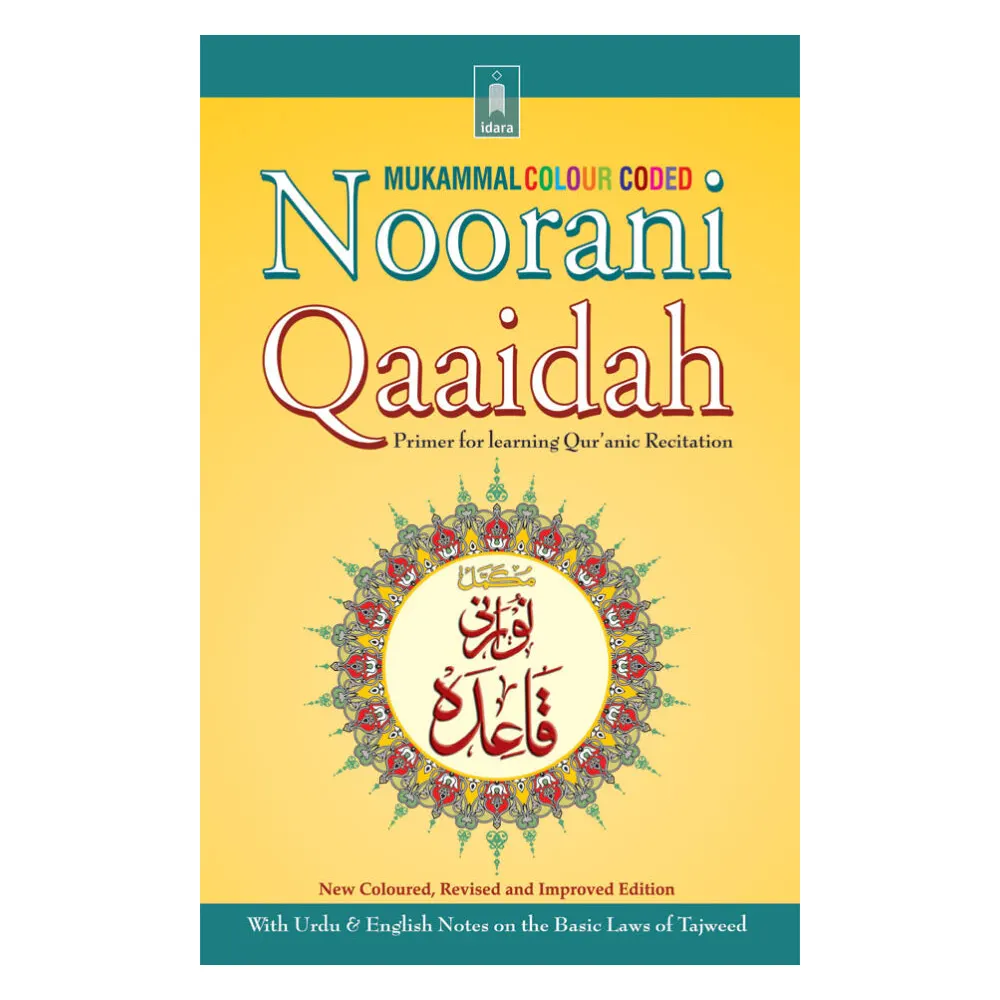
Noorani Qaidah (Idara) Arabic/English
₹45.00
- Benefits of Learning Noorani Qaida
Learning Noorani Qaida has many benefits for young learners:
- Foundation for Quranic Recitation: It builds a strong base for reading the Quran.
- Correct Pronunciation (Tajweed): Children learn proper sounds and rules to avoid mistakes.
- Confidence in Reading Arabic: By reading step by step, children gain fluency and confidence.
- Encourages Regular Practice: Noorani Qaida is designed to engage children through fun exercises and games.
- Facilitates Quran Memorization (Hifz): Once children can read fluently, they can start memorizing verses with ease.
Out of stock
- Delivery & Return
Shipping Policy
How Does The Delivery Process Work ?
- Once Our System Processes Your Order, Your Products Are Inspected Thoroughly To Ensure They Are In Perfect Condition.
- After They Pass Through The Final Round Of Quality Checks, They Are Packed And Handed Over To Our Trusted Courier Partners.
- Our Delivery Partners Then Bring The Package To You At The Earliest Possibility. In Case, They Are Unable To Reach Your Provided Address Or At A Suitable Time, They Will Contact You To Resolve The Issue.
How Are Items Packed ?
We Package Our Products In Corrugated Boxes, Which Are Covered With 3 Layer Protection. Each Individual Product Is Packed In Bubble Wrap While Fragile Items Like Bottles Are Safely Secured With Additional Bubble Wrap. We Pride Ourselves On The Quality Of Our Packaging.What Is The Range Of Locations To Which Souq Al Buhair Ships It’s Products ?
We Shipped Our Products Pan India!My Order Has Been Shipped, How Can I Track It ?
Once Your Order Has Been Dispatched, You Will Receive An Email And SMS With Tracking Details.You Can Track The Status Of Your Order Within 24 – 48 Hours After Your Order Is Dispatched From Our Warehouse.Following Are Some Of Our Trusted Courier Partners: eKart Logistics, BlueDart, Delhivery, Xpressbees, Ecom Express, DTDC & ShadowfaxWhat Is The Estimated Delivery Time ?
It Takes 3-7 Business Days To Deliver The Order Once Order Has Been Dispatched.Though We Keep 95% Of Our Catalog In Our Inventory, Certain Products Need To Be Sourced Directly From The Brand Itself So That We Can Live Up To Our Promise Of Providing Fresh, Non-expired Products.Are There Any Shipping Charges Applicable To My Order ?
We Have Dynamic Shipping Charges – Depending On Carts Total Weight/Dimension Charge Is Applied To All Orders Below ₹1999, While There Is Free Shipping For All Orders Above ₹1999.Package Weight Must Be Below 1000GM Eligible For Free Shipping .Note: Please Take A Video/Photos While Opening A Order You Received We Need It If Anything Goes Wrong With You Order Between Journey Of Our Warehouse To Your Doorstep, If You Find Order Is Damaged Or Intact Please Do Not Accept The Order Delivery .
Disclaimer: Any Complaints Related To Product/Delivery Should Be Brought To Our Notice Within 48 Hours From The Time Of Delivery.
Help
Give us a shout if you have any other questions and/or concerns. Email: support@souqalbuhair.com Phone: +918755551188 WhatsApp: +918755551188
Noorani Qaida (Idara) – Arabic/English
1. Introduction to Noorani Qaida
Noorani Qaida is a beginner’s guide for learning how to read the Quran in Arabic. It is specially designed for children and beginners who want to recite the Quran correctly with Tajweed rules. The word “Noorani” means “light,” symbolizing the light of knowledge that guides learners in reading the holy Quran properly.
The main aim of Noorani Qaida is to teach Arabic letters, pronunciation, and basic Tajweed rules step by step. Children learn in small, easy-to-follow lessons, which makes reading Arabic fun and easy.
2. Arabic Alphabet (Huruf)
The first step in Noorani Qaida is learning the Arabic alphabet. Children are introduced to all 28 letters of the Arabic language.
Each letter has a name, shape, and sound.
Letters are taught individually, then in combination with Harakat (short vowels):
Fatha ( ـَ ): short “a” sound
Kasra ( ـِ ): short “i” sound
Damma ( ـُ ): short “u” sound
For example:
ب + Fatha = بَ = Ba
ت + Kasra = تِ = Ti
ج + Damma = جُ = Ju
Learning letters with vowels ensures that the child can pronounce words correctly.
3. Joining Letters (Sukun & Tanween)
After mastering individual letters, children learn how to join letters to form simple words. Noorani Qaida teaches them the rules of Sukun (no vowel) and Tanween (double vowel sounds).
Sukun ( ْ ): Shows that a letter is silent or has no vowel.
Example: مْ in the word أَمْ
Tanween (ً ٍ ٌ): Represents “an,” “in,” “un” sounds at the end of words.
Example: كِتَابٌ = Kitabun
This step helps children in word formation and fluency in reading.
4. Madd and Rules of Pronunciation
Noorani Qaida gradually introduces Madd letters (long vowels):
Alif (ا): extends the “a” sound
Waw (و): extends the “u” sound
Ya (ي): extends the “i” sound
Children learn to lengthen sounds properly, which is essential in Quranic recitation. Noorani Qaida also teaches other basic Tajweed rules, like:
Qalqalah: echoing sound of letters like ق, ط, ب
Ghunna: nasal sound for letters like م, ن
Idgham: merging letters for smooth recitation
5. Simple Words and Sentences
After learning letters and basic rules, children begin reading simple Quranic words. For example:
مَا، رَبَّ، كِتَابَ
Then, short sentences are introduced, combining learned words:
بِسْمِ اللّٰهِ الرَّحْمٰنِ الرَّحِيْمِ
At this stage, Noorani Qaida emphasizes correct pronunciation and intonation, so children start developing fluency and confidence.
6. Exercises and Practice (Mashq)
Noorani Qaida includes many exercises, called Mashq, for practice:
Repeated reading of letters
Combining letters into words
Reading small phrases and sentences
Listening to teacher or audio recitation
This repetitive practice helps children to memorize letter shapes, sounds, and Quranic words efficiently.
7. Benefits of Learning Noorani Qaida
Learning Noorani Qaida has many benefits for young learners:
Foundation for Quranic Recitation: It builds a strong base for reading the Quran.
Correct Pronunciation (Tajweed): Children learn proper sounds and rules to avoid mistakes.
Confidence in Reading Arabic: By reading step by step, children gain fluency and confidence.
Encourages Regular Practice: Noorani Qaida is designed to engage children through fun exercises and games.
Facilitates Quran Memorization (Hifz): Once children can read fluently, they can start memorizing verses with ease.
8. Teacher’s Role in Noorani Qaida
The teacher or instructor plays an important role in guiding children through Noorani Qaida:
Demonstrates proper pronunciation of letters and words
Corrects mistakes gently to ensure accuracy
Uses interactive teaching techniques like flashcards, repetition, and audio
Encourages children to practice daily to build reading skills
Parents can also support at home by listening to recitation, encouraging practice, and praising correct reading.
9. Learning in a Step-by-Step Manner
Noorani Qaida is structured in progressive steps:
Learn letters individually
Learn vowels (Harakat)
Join letters to form words
Learn short sentences
Practice pronunciation rules (Tajweed)
Read simple Quranic verses
Continue daily practice
This gradual learning ensures children do not feel overwhelmed and enjoy the learning process.
10. Fun and Interactive Methods
To make learning engaging, teachers often use:
Colorful flashcards with letters and words
Audio recitations for correct pronunciation
Games like matching letters with sounds
Storytelling with short Quranic verses
This helps children stay interested and motivated to learn Quranic recitation.
11. Importance of Early Learning
Starting Noorani Qaida at an early age has great benefits:
Children’s brains are more receptive to language learning.
Early familiarity with Arabic letters makes future Hifz easier.
Instills love and respect for the Quran from childhood.
12. Summary
Noorani Qaida (Idara) is an essential tool for beginners to learn Quranic reading step by step. It provides:
Introduction to Arabic letters and vowels
Learning letter combinations and simple words
Rules of Tajweed for correct pronunciation
Exercises for fluency and confidence
Support for memorization and proper recitation
With consistent practice, children can read Quran fluently, understand the beauty of Arabic words, and gain confidence in recitation. Noorani Qaida acts as a light (Noor) guiding young learners toward proper Quranic learning.
Based on 0 reviews
| 0% | ||
| 0% | ||
| 0% | ||
| 0% | ||
| 0% |
Only logged in customers who have purchased this product may leave a review.
Related Products
- Biography Of Hadrat Moulana Muhammad Yusuf Sahib(R.A) Amire Tabligh Maulana Mufti Azizur-Rehman Bijnori Idara (English)
- 1. Early Life and Background
- Hadrat Moulana Muhammad Yusuf Sahib (R.A) was born in the late 19th or early 20th century in India, into a family committed to Islamic learning and piety. Maulana Mufti Azizur-Rehman Bijnori highlights that his upbringing in a spiritually rich environment laid the foundation for his lifelong dedication to Islamic scholarship and da‘wah (missionary work).
- From an early age, he displayed qualities of sincerity, devotion, discipline, and humility. His family emphasized both religious education and moral training, cultivating in him a love for Qur’an, Hadith, and the practices of the Prophet Muhammad (S.A.W.).
- 2. Education and Religious Formation
- The biography emphasizes Moulana Muhammad Yusuf Sahib’s thorough grounding in Islamic sciences. He studied:
- Tafsir (Qur’anic exegesis)
- Hadith (Prophetic traditions)
- Fiqh (Islamic jurisprudence)
- Aqidah (Islamic creed)
- His teachers recognized his intelligence, piety, and commitment to learning, which allowed him to excel in both religious knowledge and practical application. This strong scholarly foundation later helped him lead, guide, and inspire followers in Tablighi activities across India and beyond.
- 3. Early Involvement in Tabligh Work
- The book narrates Moulana Yusuf Sahib’s early participation in Tablighi activities under the guidance of senior scholars and leaders of the movement. He actively engaged in:
- Missionary journeys (khuruj): Traveling to various towns and villages to invite Muslims to observe Islamic practices.
- Spiritual training of disciples: Teaching sincerity, humility, and moral reform.
- Organization and administration: Assisting in the structured planning of Tablighi missions.
3 in stock
- Bahishti Zewar : Heavenly Ornaments (ENGLISH) Ashraf Ali Thanvi’s best selling book of advice specially for the Muslim Woman.
2 in stock
- Clear explanations of grammar and syntax – building on earlier concepts and introducing more complex structures.
- Thematic vocabulary expansion – covering practical, daily, and religious contexts.
- Reading and writing exercises – enhancing fluency, comprehension, and accuracy.
- Conversational practice – providing dialogues and situational examples for practical communication.
- Integration of Islamic vocabulary – helping learners understand religious texts alongside modern usage.
- Interactive exercises and revision sections – encouraging active engagement and reinforcement.
- Pronunciation guidance – ensuring accurate articulation of challenging Arabic sounds.
- Structured progression – lessons build logically from simple to more advanced concepts.
- Emphasis on practice and application – enabling learners to internalize knowledge and use it confidently.
2 in stock
- Beautiful Islamic Names For Children Islami Kitab Ghar (English)
- Benefits for Families
- Ease in Selecting Appropriate Names:
- Families can quickly find suitable names with clear meanings and guidance.
- Moral and Spiritual Awareness:
- Encourages parents to choose names that reflect positive values and Islamic teachings.
- Cultural and Religious Education:
- Children and families learn about the significance of names in Islam and Islamic history.
- Enhanced Identity Formation:
- Names chosen with care can inspire children’s character, virtues, and self-esteem.
- Practical Guidance:
- Provides advice on avoiding names with negative meanings and selecting names that are socially and religiously appropriate.
- Long-Term Value:
- Serves as a reference book that families can use for future generations.
1 in stock
1. Islam as a Religion of Peace
2. The Prophetic Model of Peaceful Struggle
3. Misinterpretations of Jihad
4. Islam and Interfaith Harmony
5. Islam and Modern Civilization
6. The Spiritual Dimension of Islam
1 in stock
- Allah Ka Tasavvur (Concept of Allah)
Bachon ko pehle Allah ka tasavvur karwaya jata hai. Allah hamara khaliq hai. Allah sab kuch banata hai – aasmaan, zameen, phool, ped, janwar aur hum insaan bhi Allah ne banaye. Allah har cheez ko dekhta hai aur hamesha hamare saath hota hai. Bachon ko ye samjhana zaruri hai ke Allah sab se bara aur sab se accha hai. - 2. Allah Ki Ibadat (Worship of Allah)
Bachon ko ibadat ki ahmiyat samjhayi jati hai. Ibadat ka matlab hai Allah ki baat man’na aur uski khushi ke liye kaam karna. Bachon ko ye sikhaya jata hai ke Allah ke liye namaz, dua aur acchai karna zaruri hai. Simple shabdon me, “Allah ki baat sunna aur acchai karna ibadat hai.” - 3. Dua aur Salam (Prayers and Greetings)
Nursery ke bachon ko chhoti chhoti duaen sikhayi jati hain, jaise: - Bismillah (Kuch bhi shuru karne se pehle bolna)
- Alhamdulillah (Shukriya ada karne ke liye)
- Assalamu Alaikum (Salaam karna)
Bachon ko bataya jata hai ke ye shabd hamare liye barkat aur mohabbat laate hain. Salam karna aur dua karna insaan ko shafqat aur acchai sikhata hai. - 4. Nabiyon Ka Ta’aruf (Introduction to Prophets)
Nursery bachon ko sabse pehle Hazrat Muhammad ﷺ aur kuch dusre nabi ke bare me sikhaya jata hai. Simple kahaniyon ke zariye: - Hazrat Adam A.S – pehle insaan
- Hazrat Nuh A.S – jo barkhata aur insano ko Allah ka hukum batate the
- Hazrat Muhammad ﷺ – akhir ke nabi, sabse pyare aur sabko acchai sikhane wale
Bachon ko ye samjhaya jata hai ke nabi hamesha sach bolte the aur Allah ki baat manate the.
2 in stock
- Asharah Mubash-Sharah Muhammad Iqbal Siddiqi Idara (English)
- Key Themes and Lessons
- 1. Faith and God-Consciousness (Taqwa)
- Belief in Allah is the foundation of all moral action.
- Taqwa entails awareness of Allah in thought, speech, and action, guiding believers toward ethical and responsible living.
- The book emphasizes that spiritual mindfulness leads to moral clarity, self-discipline, and inner peace.
- 2. Honesty and Truthfulness (Sidq)
- Truthfulness is central to Islamic ethics.
- The author highlights the importance of being honest in speech, business, and personal dealings.
- Deception and falsehood undermine trust, social cohesion, and spiritual integrity.
- 3. Patience and Perseverance (Sabr)
- Life is full of trials; patience is a key virtue.
- The book explains that endurance through hardship, maintaining moral standards, and resisting temptation are forms of spiritual strength.
- Patience is closely linked to reward in the Hereafter.
1 in stock
- Az-Zaujus Salih The Pious Husband Majlisul Ulama Of South Africa Idara (English)
2 in stock
- Paperback
- Publisher: Idara impex (2006)
- Language: English
2 in stock
- Illustrations and Visual Appeal
The book contains colorful and detailed illustrations showing: - Hazrat Umar (RA) in daily life, prayers, and leadership moments.
- Key events like battles, governance, and social reforms.
- Scenes depicting Islamic culture and lifestyle during the Prophet’s time.
- Illustrations help visual learners understand history and make stories more memorable and interesting.
- 12. Educational and Spiritual Benefits
Reading this book provides multiple benefits for children: - Historical Knowledge: Introduces early Islamic history and life of companions.
- Moral Development: Teaches virtues like justice, courage, and honesty.
- Spiritual Awareness: Encourages children to reflect on their faith and relationship with Allah.
- Role Modeling: Hazrat Umar (RA) becomes a role model for children in behavior, faith, and leadership.
4 in stock
- Quran Stories For Toddlers Board Book Saniyasnain Khan (Goodword) Arabic
1 in stock
- The syllabus begins by introducing the concept of Allah as the Creator, Sustainer, and Most Merciful.
- Children are taught in simple Urdu phrases that Allah loves them, watches over them, and provides for all creatures.
- The idea of Tawheed (Oneness of Allah) is presented in a way that young minds can grasp, often through short sentences, stories, or illustrations showing Allah’s care in nature, family, and daily life.
- By teaching children about Allah’s attributes at an early age, the syllabus lays the foundation for developing love, respect, and trust in the Creator.
- Another key focus of Nursery Nisab 02 (Deeniyat) is the introduction to the life of the Prophet Muhammad (PBUH).
- The curriculum narrates simple stories about the Prophet’s kindness, honesty, and compassion.
- Children learn about his role as a messenger of Allah, his care for others, and his exemplary moral character.
- Stories are short, illustrated, and delivered in simple Urdu sentences, making them easy to understand and remember.
- These narratives are designed to teach children core moral values such as honesty, patience, respect, and generosity through the actions and teachings of the Prophet (PBUH).
2 in stock


Reviews
There are no reviews yet.