
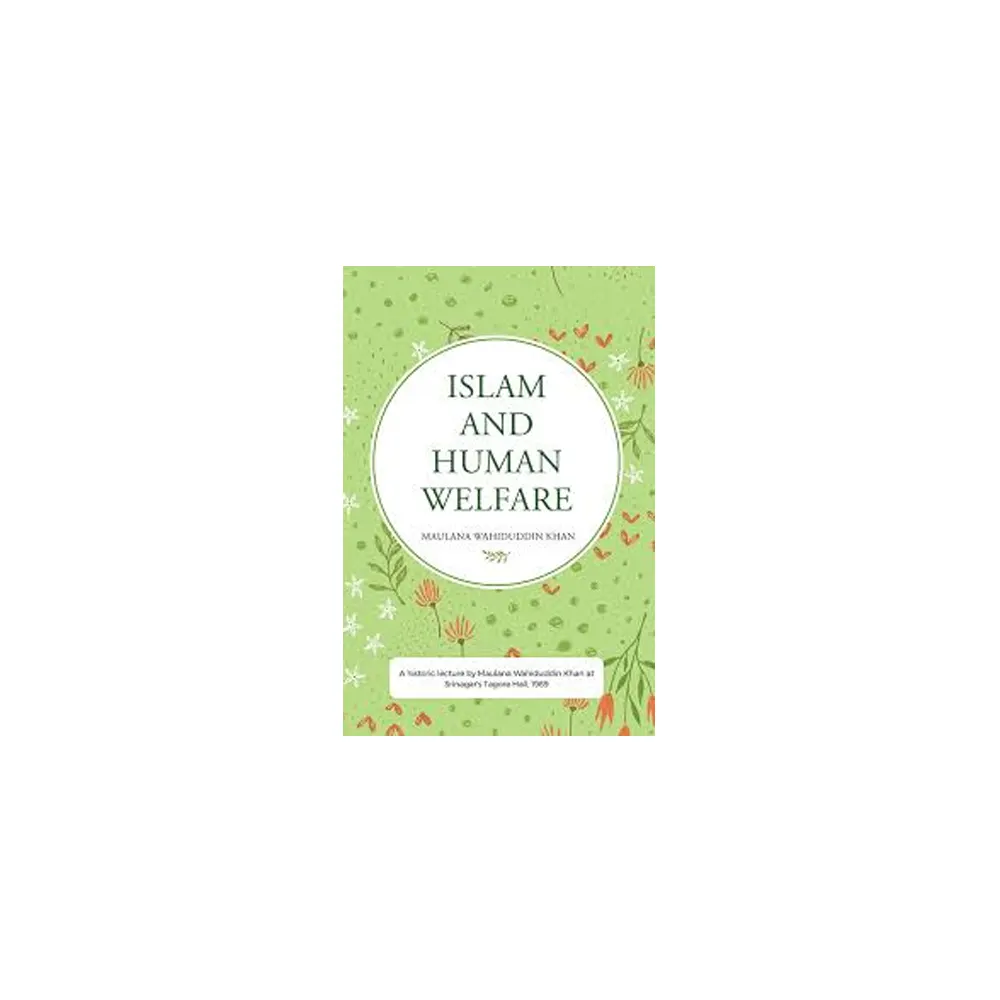
Islam And Human Welfare Pb (Maulana Wahiduddin Khan) Goodword English

Original price was: ₹50.00.₹38.00Current price is: ₹38.00.
- Knowledge empowers individuals to improve their lives.
- Education creates awareness, tolerance, and understanding in society.
- The Qur’an encourages reflection, reasoning, and learning from nature.
- Early Muslim civilization excelled in science, medicine, and philosophy, serving humanity through discoveries and innovations.
Out of stock
Islam And Human Welfare Pb (Maulana Wahiduddin Khan) Goodword English
Introduction
Maulana Wahiduddin Khan, a renowned Islamic scholar, thinker, and peace activist, wrote “Islam and Human Welfare” to show how Islam is not only a religion of rituals but also a complete way of life dedicated to the well-being of humanity. He emphasizes that Islam’s teachings are not confined to prayer and fasting alone but extend to justice, compassion, charity, education, social harmony, and peace.
This book explains that the essence of Islam is service to humanity (khidmat-e-khalq) because Allah created all human beings as His dependents, and the best among people are those who bring benefit to others. By exploring the Qur’an, Hadith, and Islamic history, Maulana Wahiduddin Khan shows that true religiosity is inseparable from human welfare.
Islam as a Religion of Mercy
The Qur’an describes Prophet Muhammad ﷺ as a “mercy to the worlds” (Rahmatul-lil-Alamin). This means that the Prophet’s mission was not limited to guiding Muslims but to ensure the welfare of all humanity. Islam emphasizes:
Mercy towards the poor and needy.
Kindness to neighbors and strangers.
Justice for the oppressed.
Respect for human dignity regardless of religion, race, or status.
The author stresses that Islam came to uplift the weak, defend the rights of the marginalized, and establish a society based on justice and compassion.
Human Welfare as the Core of Worship
Maulana Wahiduddin Khan explains that Islamic acts of worship (ʿibadat) are directly linked with human welfare:
Salah (Prayer): Builds discipline and moral awareness, which translates into honesty and fairness in daily life.
Zakah (Charity): A financial system to redistribute wealth, prevent poverty, and ensure that no one is left hungry.
Sawm (Fasting): Creates empathy for the poor, making people more generous and caring.
Hajj (Pilgrimage): A reminder of human unity and equality, where Muslims of all nations come together as one community.
Thus, the spiritual pillars of Islam nurture social responsibility and promote welfare for all.
Economic Justice in Islam
One of the strongest themes in the book is Islam’s concern for economic justice. According to Maulana Wahiduddin Khan, Islam discourages the hoarding of wealth and exploitation, while encouraging trade, fair distribution, and charity. Key principles include:
Prohibition of Riba (interest): To prevent the rich from exploiting the poor.
Encouragement of Charity: Through zakah, sadaqah (voluntary charity), and waqf (endowments).
Balanced Lifestyle: Islam discourages extravagance and waste, promoting moderation and responsible spending.
Work as Worship: Earning a lawful livelihood is seen as a form of serving humanity.
These principles ensure that wealth circulates fairly, helping society progress collectively.
Social Justice and Equality
The book highlights Islam’s emphasis on justice (‘adl) as a foundation of welfare. The Qur’an repeatedly commands Muslims to “stand firmly for justice, even against yourselves or your kin.”
Maulana Wahiduddin Khan explains that:
All humans are equal: Islam rejects racial, tribal, and class-based superiority.
Rights of women: Islam granted women inheritance rights, dignity, and protection long before modern societies recognized them.
Care for minorities: Non-Muslims living in a Muslim society (dhimmis) are to be protected and given their rights.
Justice for the weak: Courts, rulers, and leaders are accountable to ensure fairness in society.
Islam views justice as a form of welfare because a just society automatically provides peace, security, and dignity to its people.
Education and Knowledge as Human Welfare
The Prophet ﷺ said: “Seeking knowledge is obligatory upon every Muslim.” Maulana Wahiduddin Khan highlights that Islam considers knowledge and education as essential tools for welfare.
Knowledge empowers individuals to improve their lives.
Education creates awareness, tolerance, and understanding in society.
The Qur’an encourages reflection, reasoning, and learning from nature.
Early Muslim civilization excelled in science, medicine, and philosophy, serving humanity through discoveries and innovations.
Thus, Islam views education not as a privilege but as a duty for the collective good of humanity.
Compassion and Service to Others
According to Maulana Wahiduddin Khan, Islam defines true faith not by rituals alone but by how we treat others. The Prophet ﷺ said: “The best of people are those who are most beneficial to others.”
Examples of human welfare in Islam include:
Feeding the hungry.
Caring for orphans and widows.
Visiting the sick.
Freeing slaves and ending oppression.
Being kind to animals.
Protecting the environment.
This broad view of welfare shows that Islam’s concern extends to all creation, not just humans.
Islam and Peaceful Coexistence
The author emphasizes that Islam promotes peaceful coexistence with people of all religions and cultures. The Qur’an teaches that diversity among humans is part of Allah’s plan: “We made you into nations and tribes so that you may know one another.”
Islam encourages dialogue instead of conflict.
Treating neighbors, whether Muslim or non-Muslim, with kindness is a religious duty.
War in Islam is only a last resort for defense, never for oppression.
True welfare is achieved when societies live in peace, allowing human potential to flourish.
Historical Examples of Human Welfare in Islam
Maulana Wahiduddin Khan provides historical examples to show how Islamic principles have always been tied to human welfare:
The Prophet Muhammad ﷺ: He established brotherhood between migrants (Muhajirun) and helpers (Ansar) in Madinah, ensuring no one was left without support.
Umar ibn al-Khattab (RA): As Caliph, he introduced social welfare policies, stipends for the poor, and state responsibility for orphans and widows.
Islamic Civilization: Hospitals, universities, libraries, and charitable institutions flourished under Muslim rule, benefitting not only Muslims but people of all backgrounds.
These examples highlight that Islamic governance historically prioritized the welfare of people.
Spiritual Welfare – Inner Peace
Maulana Wahiduddin Khan also discusses spiritual welfare, which is as important as material welfare. Islam provides guidance for inner peace by:
Encouraging remembrance of Allah (dhikr).
Teaching patience and gratitude.
Removing jealousy, hatred, and arrogance from the heart.
Promoting forgiveness and reconciliation.
Spiritual welfare ensures that people live with contentment and spread positivity in society.
Islam’s Universal Message of Welfare
The author concludes that Islam’s message of welfare is not limited to Muslims. The Qur’an repeatedly emphasizes justice, compassion, and kindness for all of humanity. Prophet Muhammad ﷺ said: “All creatures are Allah’s dependents, and the most beloved of them to Allah are those who are most beneficial to His dependents.”
This shows that Islam’s vision of welfare is universal. It applies to Muslims, non-Muslims, animals, and the environment. A true believer is someone whose presence brings goodness and relief to others.
Conclusion
Maulana Wahiduddin Khan’s “Islam and Human Welfare” is a powerful reminder that the essence of Islam lies in service, compassion, justice, and peace. It explains that every act of worship in Islam is connected with social responsibility and that the true measure of faith is seen in how much benefit one brings to others.
The book argues that Islam’s guidance—whether in economics, justice, education, or spirituality—always aims at human well-being. It portrays Islam as a religion of universal mercy, one that elevates the individual, strengthens society, and promotes global peace.
In today’s world, where materialism, inequality, and conflict are common, the teachings of Islam as explained in this book serve as a blueprint for human welfare and harmony.
Only logged in customers who have purchased this product may leave a review.
Reviews
There are no reviews yet.